Solutions to save the planet, protecting childhood from algorithms, and the new world map, plus more good news
This week’s good news roundup

Academics have identified 51 ready-to-go environmental solutions which they say, with the right support, could trigger an “unstoppable” wave of positive change that would rapidly repair the planet.
The research builds on the notion of tipping points. Many people are familiar with the concept of negative tipping points, where one component of an ecosystem collapses, sparking a chain of unstoppable disasters.
However, an emerging field of study turns the idea on its head, focusing instead on positive tipping points. Furthering the research this week, academics published 51 solutions that could create a wave of positive change, as happened with solar power and global mangrove restoration efforts.
Many of the solutions have already been implemented, with some winning an Earthshot Prize for their impact. One is reintroducing big beasts to landscapes, shown to increase biodiversity, CO2 absorption and tourism. Others include supply chain reform, expanding clean air zones, Indigenous stewardship of land, and creating more marine protected areas – a boon for nature and coastal communities.
Prof Tim Lenton from the University of Exeter, England, which led the research, said the tipping points it identifies “represent the best chance of repairing our planet”. His work comes as a United Nations report warns the world is on course to breach 1.5C of warming.
Related: How positive tipping points could trigger unstoppable change
Image: iStock

For years, China has deployed more renewables than the rest of the world combined, while also increasing coal generation – a paradox that means it’s both a green energy leader and the world’s largest emitter.
However, new research suggests that renewables are starting to replace fossil fuels across the country, with experts claiming a “handover” is well underway.
According to Ember, the thinktank behind the analysis, coal generation has stalled in 17 out of 26 Chinese provinces and regions, including industrial centres such as Shandong.
Meanwhile, fossil fuel use has peaked in eight out of 11 industrial sectors, Ember added, noting that 26% of China’s new truck sales in 2025 were electric, a share many European nations only just reached for passenger cars.
“The clean electricity system is gaining both strength and scope, and the fossil fuel system is already registering the shift,” said Dr Muyi Yang, a senior analyst at Ember. “You can see fossil fuel use flattening out, sector by sector and province by province.”
There’s still a long way to go. China remains heavily dependant on coal and oil. But a major shift is underway and the implications will “extend far beyond [China’s] borders”, said Ember.
Image: Michael Held

The United Nations has voted to replace the traditional world map with one that reflects Africa’s true size.
The current Mercator map – used since the 16th century – depicts Africa as roughly the same size as Greenland, despite it being around 14 times larger.
The misrepresentation is because it’s impossible to accurately present a spherical world on a flat surface. This means countries along the equator appear smaller than they should do on the Mercator map. While the new Equal Earth map corrects such misrepresentations, it sacrifices distance accuracy instead, and thus can’t be used for navigation.
The ‘correct the map’ resolution was sponsored by the African nation Togo, and passed with the support of 164 countries, including France and the UK. The US was the only nation to vote against it.
“A fair world begins with a fair map,” Togolese foreign minister Robert Dussey told Reuters. “A map is never neutral. It shapes perceptions, influences how the place of peoples and continents in the world is understood.”
Image: Tom Patterson

Holding off giving children a smartphone is better for their wellbeing, first-of-its-kind research finds.
In the absence of a nationwide smartphone ban in UK schools, many parents have taken matters into their own hands, collectively agreeing to put off giving their children a device. The idea was pioneered by the Smartphone Free Childhood campaign, founded by former Positive News editor Daisy Greenwell.
Now, a study involving 12,000 English primary schools finds that where at least one fifth of families formed such a pact, school-recorded support needs fell by 8.2%, while child psychiatric disability claims fell by 6%.
The study has yet to be peer reviewed, but author Gregory Veramendi, an economist at the University of London, said it was the “first causal evidence that coordinated delay of smartphones improves children’s mental health”.
“For parents who chose to delay smartphones for their children, often when it felt like everyone else was doing the opposite, this is an extraordinary moment,” said Greenwell.
“Delaying a smartphone isn’t about what you’re taking away from your child – it’s about everything you’re giving back. More time, better sleep, real-world friendships, space to play and the ability to focus. In a world of constant connectivity, those things are fast becoming superpowers.”
Image: iStock

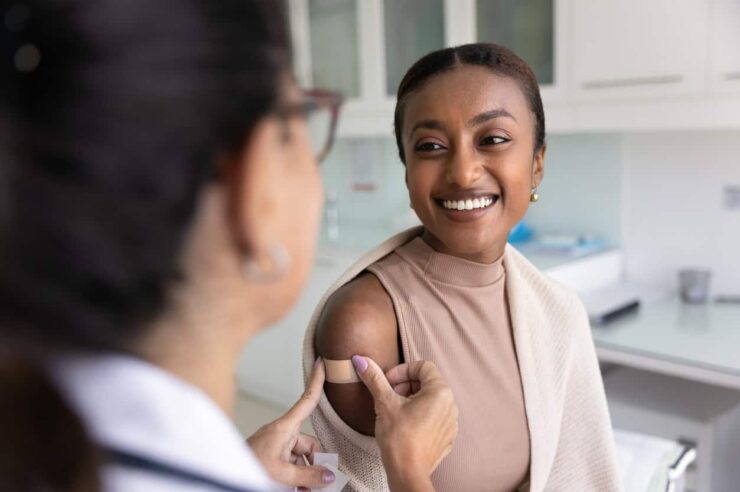
Apple and Google will be forced to block explicit images on children’s phones in the UK under proposed new legislation.
The two firms, which dominate the UK handset market, were given a three-month deadline by the government to submit proposals for preventing under-18s from generating, sharing and seeing nude images on their devices.
That expired this week and failed to produce proposals that “meet the scale of this crisis”, according to Lisa Nandy, secretary of state for digital, culture, media, and sport.
“Children are facing unacceptable levels of sexual harm online,” she said. “In no other walk of life would we tolerate this crisis. We will not tolerate it online.”
The legislation would require safeguards to be built into devices and switched on “by default”. Children’s charities welcomed the announcement, but privacy campaigners raised concerns as it would require adults to verify their ages, thus surrendering more personal data.
Google said that it is “fully committed to continuing to work with experts, legislators, app developers and device manufacturers to keep children safe”. Apple said: “We share the UK’s commitment to combating exploitation and abuse online”, adding it had plans to strengthen child safety tools.
Image: Vitaly Gariev

Social media users in Australia are to be given the right to turn off algorithms pushing unsolicited content onto their feeds, the government said this week.
Australian prime minister, Anthony Albanese, announced the proposals in a press conference on Tuesday, claiming: “We’re taking power from big global tech companies and giving it to ordinary Australians. It’s the right thing to do.”
Australia was the first country to ban under-16s from social media. Under it’s latest plans, social media platforms would have to give users an opt out for receiving algorithm-driven content, or face fines of up to A$100m (£53m). Tech firms will also be obliged to protect young users from pornography and content promoting eating disorders, crime or abuse.
The proposals were criticised by some opposition parties, which claim they are an attempt to censor the internet. They also tee up a potential clash with big tech and its cheerleaders in the White House.
“There will be opponents, because what this is about is changing the power relationship,” Albanese said. Anika Wells, communications minister, added: “There is a global reckoning coming for big tech.”
Image: Nathan Dumlao

People think that London is far more dangerous than it actually is despite research pointing to a fall in crime across the English capital.
That’s according to a new study published by King’s College London. Based on surveys of some 5,000 people, it found that 62% of participants believed that crime had increased in London between 2019 and 2025, when actually it fell by 1.4%. Meanwhile, 40% thought the murder rate had risen, when it dropped by around 15%.
Among those fuelling the perception gap is US president Donald Trump, who recently falsely claimed there was “no law and order” in parts of London. A similar phenomenon exists in his native US, where there’s been a historic fall in violent crime, despite many thinking the opposite.
Some crimes, however, are on the rise, including shoplifting, which helps fuel perception gaps.
“Misperceptions about London matter because the capital has become a lightning rod in our national debate – deeply connected to arguments about crime, immigration and the direction of the country,” said researchers. “This study shows people… are far too negative about the realities in London.”
Image: Lucas Davies

Bhutan has become the first country in south-east Asia to eliminate dog-transmitted rabies as a public health problem, the World Health Organization (WHO) said this week.
Rabies is a viral disease that is usually fatal once symptoms appear. However, deaths can be prevented by vaccinating dogs and administering a human rabies vaccine immediately after a bite.
According to the WHO, Bhutan’s achievement follows more than a decade of investment in preventative measures.
“Health workers, veterinary professionals and volunteers … helped take dog vaccination, population management and community awareness to every part of the country,” said the WHO’s Dr Nilesh Buddha. “Bhutan’s achievement offers an important example for other countries in the region.”
Image: Pemma Chhoeden

People with a heightened risk of Alzheimer’s are set to take part in a world-first trial to explore whether an experimental drug can prevent them from developing the disease.
Screening for the global trial began in Europe this week. Would-be participants will have memory tests before being offered blood tests to see whether they have p-tau217 – a biomarker that points to a heightened risk of Alzheimer’s.
The trial, which aims to recruit 1,600 people, will investigate whether prescribing an experimental drug, trontinemab, to participants with elevated levels of p-tau217 can stop them from developing dementia. It comes after research found the drug cleared amyloid plaques in 90% of people with early-stage Alzheimer’s, thus removing a defining characteristic of the disease.
“The idea that someone alive today could become the first person cured of Alzheimer’s disease would have seemed unimaginable not long ago,” said Hilary Evans-Newton CBE, chief executive of Alzheimer’s Research UK. “Today … it’s a future we know is within reach.”
While the trial is one of the first to focus on prevention rather than cure, researchers caution that trontinemab is an investigative drug that may, ultimately, not work.
Image: Matteo Vistocco

His was the defining performance in the cult film Withnail & I, but Richard E Grant might not have landed the role were it not for his penchant for preloved clothes.
“My life-changing career break happened because I was wearing a secondhand coat I bought in an Oxfam shop,” he said, launching a new Oxfam campaign promoting preloved fashion. “It was 1986 and I arrived for my ‘Withnail & I’ audition soaking wet and in a secondhand Burberry trench coat. Turned out I’d nailed the look for the part without even trying – so, no Oxfam, no Withnail.”
The campaign launch comes as Oxfam’s new State of Style report finds that 57% of UK adults deliberately tried to buy fewer clothes during the past year.
Read more here.
Image: Sane Seven/Oxfam
Main image: iStock
Get your weekly fix of good news delivered to your inbox every Saturday, by signing up to the Positive News email newsletter
Because the world needs it
Positive News reports on the people and ideas driving progress. We believe that giving attention to solutions helps them spread.
Our journalism is independent and powered by our readers. There are no media moguls or shareholders extracting profits: your contribution funds our work to investigate what’s working, understand why, and bring those stories to a wider audience.
If you value a fuller picture of what’s happening in the world, please become a Positive News supporter today.