
Politicians may claim that ‘Britain is lawless’, but data shows that violent crime is falling – including knife crime. We speak to the people and organisations helping to make the streets safer
At 17, Samir Khattab was caught up in a gang fight, “ducking and diving” to avoid being stabbed. He was “sliced” in the head, admitted to a London hospital trauma ward, given surgical staples, then discharged. “In my day, they patched you up, then kicked you out.”
Now, at two major east London hospitals, Khattab leads a team of case workers offering bedside support to young knife crime victims. In the team’s 12th-floor office at the Royal London Hospital in Whitechapel, he sits facing a map of the capital marked with brightly coloured tabs showing postcode gangs. He explains how he and his colleagues do everything they can to prevent patients coming to harm again once they leave hospital.
Often this means arranging mental health support. “Our clinical staff address the physical wounds of our young people, but who’s going to help with the traumatic experiences that probably got them into a bad space in the first place?” The team also helps them return to education or find safe housing.

The next day, having hired a van, Khattab is set to help a family of six move home after the eldest child was stabbed.
“It’s about mitigating the risk of future harm after a perpetrator has compromised the address, and providing a fresh start.” There is no “expiry date” to the support, he adds. “We couldn’t build trust with patients if they felt they were being treated like ticked boxes.”
Khattab stresses that the work goes beyond protecting young people from future harm. It also deters them from causing harm. Victims and perpetrators overlap significantly, with 61% of teenage perpetrators of violence having also been victims, according to the Youth Endowment Fund (YEF), which invests in work preventing youth violence.
“We’re stopping victims becoming perpetrators,” Khattab says. His own experience shows what can happen when vulnerable young people are discharged without the support they need. Nobody checked on him when he was a 17-year-old with a head wound. “The services didn’t exist,” he says. A year later, Khattab was convicted of a gang-related murder and sentenced to 16 years in prison.

Samir Khattab was sentenced to 16 years in prison. Now he works to keep others away from a life of crime
“Who knows what the trajectory of my life could have been if I’d had a case worker, who’d said, ‘Yo, you alright?’ I might have opened up and said, ‘Look, I’m sofa surfing, I’ve got no stability, I have a violent peer group.’” Having grown up amid instability, including his mother facing domestic abuse and incarceration, violence became a “way to express the pain I was experiencing,” he explains.
His personal history now gives him the resilience to work with vulnerable patients. “It’s fuelled me. There’s no loss of empathy, I’m not desensitised, but I can engage with these young people because I’ve been through it.”
At times it is a “secret weapon” for engaging reluctant patients. He recalls one 14-year-old from east London who had been stabbed. “He was just looking up at the ceiling; he didn’t want to speak to me. I said, ‘You got parents coming, you got visitors? Are you good? I want to make sure that you’re being loved.’ He goes, ‘Ain’t got no parents, I’m in care.’ And I said, ‘I’ve been in care too.’ He snapped his neck, locked eyes with me and said, ‘What the heck? I never expected that.’”
Who knows what the trajectory of my life could have been if I’d had a caseworker, who said ‘Yo, you alright?’
Once a high-risk Category A inmate in Belmarsh Prison, “walking around the exercise yard with terrorists”, Khattab now feels lucky “to be able to give back”. He is clear-eyed about the past. “I’m regretful, and I put many families through pain and suffering. But I’m trying my best to right my wrongs through the work that I do.”
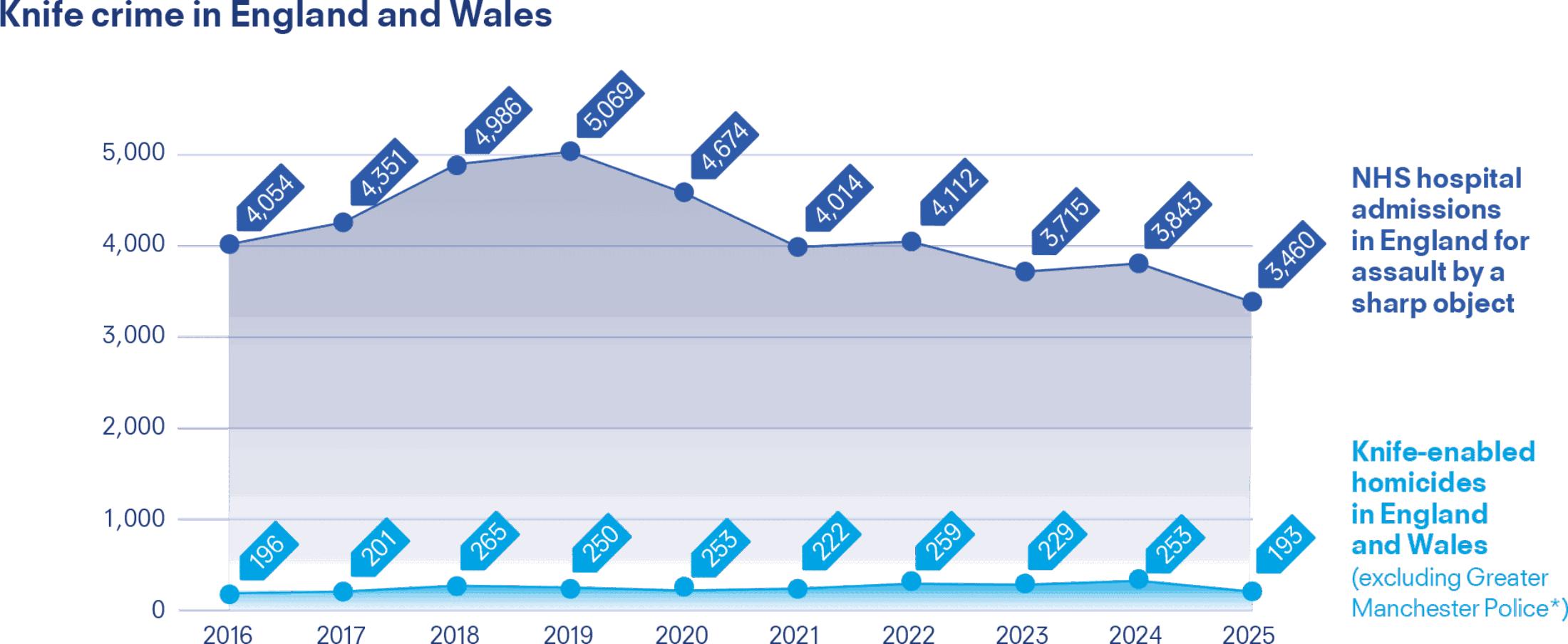
Knife crime has dominated headlines in recent years, with commentators making frenzied claims. Yet figures released by the Mayor’s Office for Policing and Crime show that the murder rate in London for the first nine months of 2025 was at its lowest since monthly records began in 2003. There has been a 50% reduction in the number of young people murdered compared to 2024, which itself saw the under-25 homicide rate fall to a 22-year low. Greater London Authority data shows knife crime fell by 19% in London between April and June 2025 compared with the same period the previous year.
Reports contending that it is currently at a record high often rely on police data, neglecting to account for improvements in police recording practices over the past decade that have had a “substantial impact” on the figures, according to the Office for National Statistics (ONS). Such trends should therefore be “interpreted with caution”, the body advises. Even when considering these figures, knife crime is still 4% lower than it was in the year ending March 2020.
Source: Office for National Statistics, World Bank, NHS England Digital
But police data is not the only metric. Knife-enabled homicides, which are less affected by recording changes, were at a six-year low and 23% lower in the year ending March 2025 than the previous year, according to the ONS. NHS England also reported a 9% decrease in knife crime admissions in 2024 to 2025 compared with the year earlier, and records for the year ending March 2025 show that hospital admissions for assault by a sharp object were lower than at any time in the previous decade.
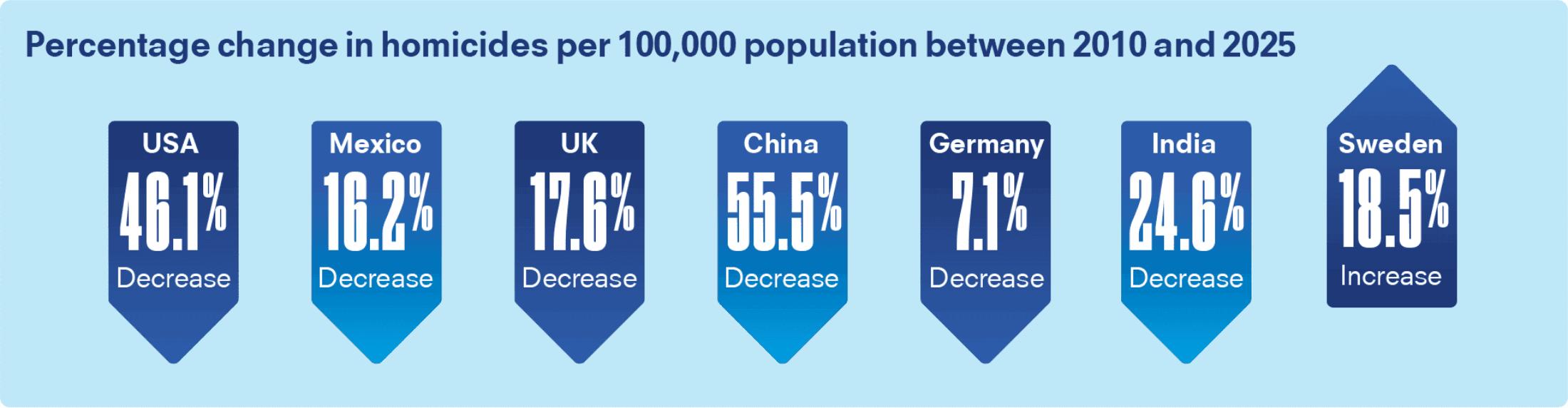
US President Donald Trump has repeatedly commented on UK knife crime, once describing a London hospital as “like a war zone for horrible stabbing wounds” in a 2018 speech to the National Rife Association, despite the US having 52% more homicides caused by knives per million people than the UK, according to the most recent available data at the time.
His comments appear to have misconstrued remarks by trauma surgeon Prof Martin Griffiths, who launched the Royal London Hospital’s violence reduction service in 2015 after despairing at seeing the same young victims return again and again. With case workers from the St Giles Trust charity, the programme has contributed to a fall in readmission rates from 35% to 2.63% for the year to March 2025.
Forming community ties is vital – we can’t arrest our way out of this issue
Ciaran Thapar, a director at the YEF and former youth worker, says there is reason for optimism. He points to the fact that there were no homicides of under-25-year-olds in London during the long 2025 summer holiday. “That’s quite remarkable, when it’s become almost a fact that the summer holiday is going to throw up some really tragic murders of teenagers in London.”
He also highlights the efforts of grassroots groups, including United Borders, founded by former prison officer and bus driver Justin Finlayson in Brent, northwest London.
After the fatal shooting of 22-year-old business studies student James Owusu-Agyekum in 2016 in a case of mistaken identity, Finlayson was determined to bring together the borough’s postcode gangs. He bought an old double-decker bus with his savings and converted it into a travelling music studio. Young residents from one area would come aboard to create rhythm tracks, then he would drive to another estate where rival youths unknowingly rapped over them, and vice versa.
Source: Office for National Statistics, World Bank, NHS England Digital
“I had to present the idea of each group working with me separately,” Finlayson explains. “After two weeks, they were really on the beats, married to the music, and we revealed to them that they’d been working together.” There was initial suspicion, here calls, “but we’d built up enough of a mentoring relationship. Then it was, ‘Okay, cool.’” Eventually both factions made music together. Today, United Borders travels across London offering mentoring and workshops wherever they are needed. “If there’s a spate of young people being harmed, we get our bus down to those places,” Finlayson says.
At points in recent years, the highest rate of police recorded knife crime in the UK has not been in London but in the West Midlands. Yet the region saw a 15% drop in these figures in the year ending March 2025, helped in part, the force believes, by a three-year pilot scheme rooted in a US model from Boston.
Focused deterrence recognises that most serious violence is committed by small groups, who themselves often have histories of trauma and difficult life circumstances.
Source: Office for National Statistics, World Bank, NHS England Digital
To assess its effectiveness in the UK, the Home Office and YEF invested £7m in focused deterrence projects at police forces in England. Although evaluation by the University of Hull is ongoing, Zeba Chowdhury, who led the West Midlands scheme, is enthusiastic about its impact.
The investment enabled the region’s violence reduction partnership to offer 24-hour support through a team of navigators. “If a young person was arrested, even if it was 2am, a navigator would visit and say ‘here’s a way out’ at that reachable, teachable moment,” Chowdhury explains. With ringfenced funding, individuals received timely support, including cognitive behavioural therapy, careers advice and help with education, training and housing.“
“It wasn’t a case of signposting them to an organisation providing mentoring, or a mental health service with a ridiculously long waiting list,” she says. Participants were contacted within 72 hours of being identified or referred, to understand their needs. Although there was no upper age limit, those aged 21 and under were four times more likely to accept support.
“One young person described their navigator as like having an assigned best friend,” Chowdhury recalls. “Bearing in mind that the navigator is a police officer, and that the young person may not have had the best relationship with authority, that was really lovely to hear.” Forming these local ties is vital, she believes. “We can’t arrest our way out of this issue.”
Photography by Laurie Fletcher
Support solutions in 2026
At Positive News, we’re not chasing clicks or profits for media moguls – we’re here to serve you and have a positive social impact. We can’t do this unless enough people like you choose to support our journalism.
Give once from just £1, or join 1,800+ others who contribute an average of £3 or more per month. Together, we can build a healthier form of media – one that focuses on solutions, progress and possibilities, and empowers people to create positive change.