
It’s the largest public investment in community-owned green power in the UK to date. But what exactly is being promised, and how can communities get involved?
The idea behind community-owned renewable energy is fairly simple. Local people get together and form a social enterprise in order to build their own commercial clean energy project, or buy shares in one. Then, the electricity generated from wind, solar or water is sold to the grid and the community directly benefits from any profits. It works – but in the UK, the proportion of power that’s generated in this way remains small.
The first project, Baywind Energy Co-op in Cumbria, launched in 1997. Since then, community energy has grown steadily, yet produces just 0.5% of the UK’s electricity. That’s despite evidence showing these projects deliver 12 times more local economic value than commercial schemes.
Now, the government is trying to change that. Through its new Local Power Plan, it has pledged £1bn for community-owned clean energy – the largest public investment of its kind in the UK. The aim is to create opportunities for communities to take “a direct stake in a clean, green, more affordable energy future.”
But what does that mean in practice?
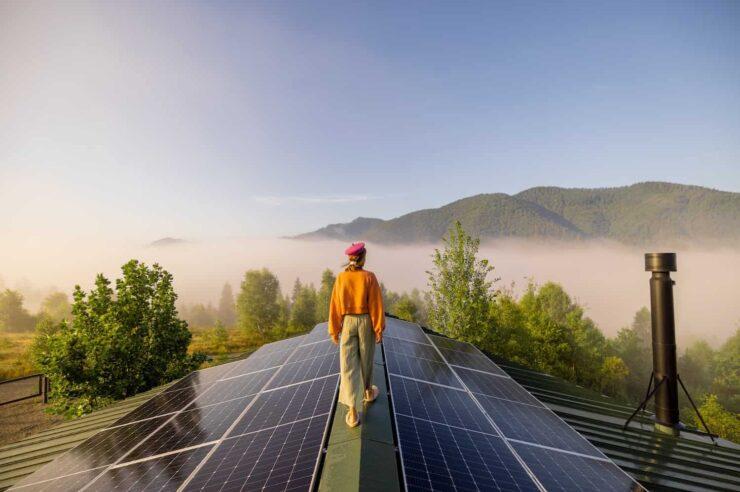
The UK government has pledged £1bn for community-owned clean energy – the largest public investment to date. Image: Evgeniy Alyoshin
The target
The plan sets a goal of delivering 8GW of locally owned clean energy by 2030 – enough, in theory, for every community in the UK to benefit from power generated nearby.
To get there, four types of support are being proposed. The first and most significant is funding. The £1bn will be distributed by Great British Energy (GBE), a new publicly owned energy company.
“It’s a catalytic piece of seed funding,” says Louise Daniels, head of external affairs at Thrive Renewables.
Some of the money will come as grants for early-stage work such as feasibility studies. Some will be loans to help build projects. The government also wants to attract private investment alongside it.
“We’re really looking forward to working with them as a commercial investor that knows this space and has been committed to community energy for 30 years,” says Daniels.
The other three types of support will come in the form of expert advice and capacity building, helping communities build scalable business models, as well as policy and regulatory reform to tackle structural barriers around shared ownership.

The aim of the Local Power Plan is to create opportunities for communities to take 'a direct stake in a clean, green, more affordable energy future'. Image: Small Group Network
The timeline
While the Local Power Plan has clearly set out what support should exist, it says less about when it will arrive or how it will be delivered. Afsheen Kabir Rashid, CEO and co-founder of Repowering London, says more detail may emerge after the mayoral elections in early May, but nothing is confirmed.
“Once you start unpacking [the Local Power Plan], there’s quite a lot of detail still to work out for us as a sector,” she says. That includes practical questions such as how projects will sell their energy, and how support will differ between urban and rural areas.
I would say to new community groups to not hold back and to start their initial galvanising, mobilising of people
“We could engage in another six months of discussion and exploration and design,” she says. But time is ticking and stakeholders such as Repowering London are impatient to get going. “This is the time for us to act and move fast,” says Kabir Rashid.
Getting involved
GBE has opened a call for expressions of interest. Groups can register to receive updates or submit early-stage project ideas for informal feedback. For those starting from scratch, support already exists. Organisations such as Community Energy England – and equivalent bodies in Scotland and Wales – offer guidance on setting up projects. Local groups including Repowering London and Community Energy Pathways can also provide hands-on support.
“I would say to new community groups to not hold back and to start their initial galvanising, mobilising of people,” says Kabir Rashid. “Get as many volunteers involved as possible, start engaging with your stakeholders and looking at sites.”
The wider context
According to Ollie Pendered, executive chair at Community Energy Pathways, the Local Power Plan is one of three major shifts needed to make renewable energy work at scale.
The second being reform of the electricity grid – known as ED3 – which will address capacity, pricing and planning. This is expected to begin in April 2028. And the third being the Warm Homes Plan, launched earlier this year. Backed by £15bn in public funding, it aims to upgrade 5m homes and lift 1m families out of fuel poverty by 2030.
“You could feel that the Local Power Plan is the be-all and end-all, but actually it’s not,” says Pendered. “It’s the enabler, because you need these other parts – the network development, as well as the Warm Homes Plan – to actually deliver renewables. These three streams need to come online to really deliver what this country needs for renewable energy.”
Main image: AscentXmedia