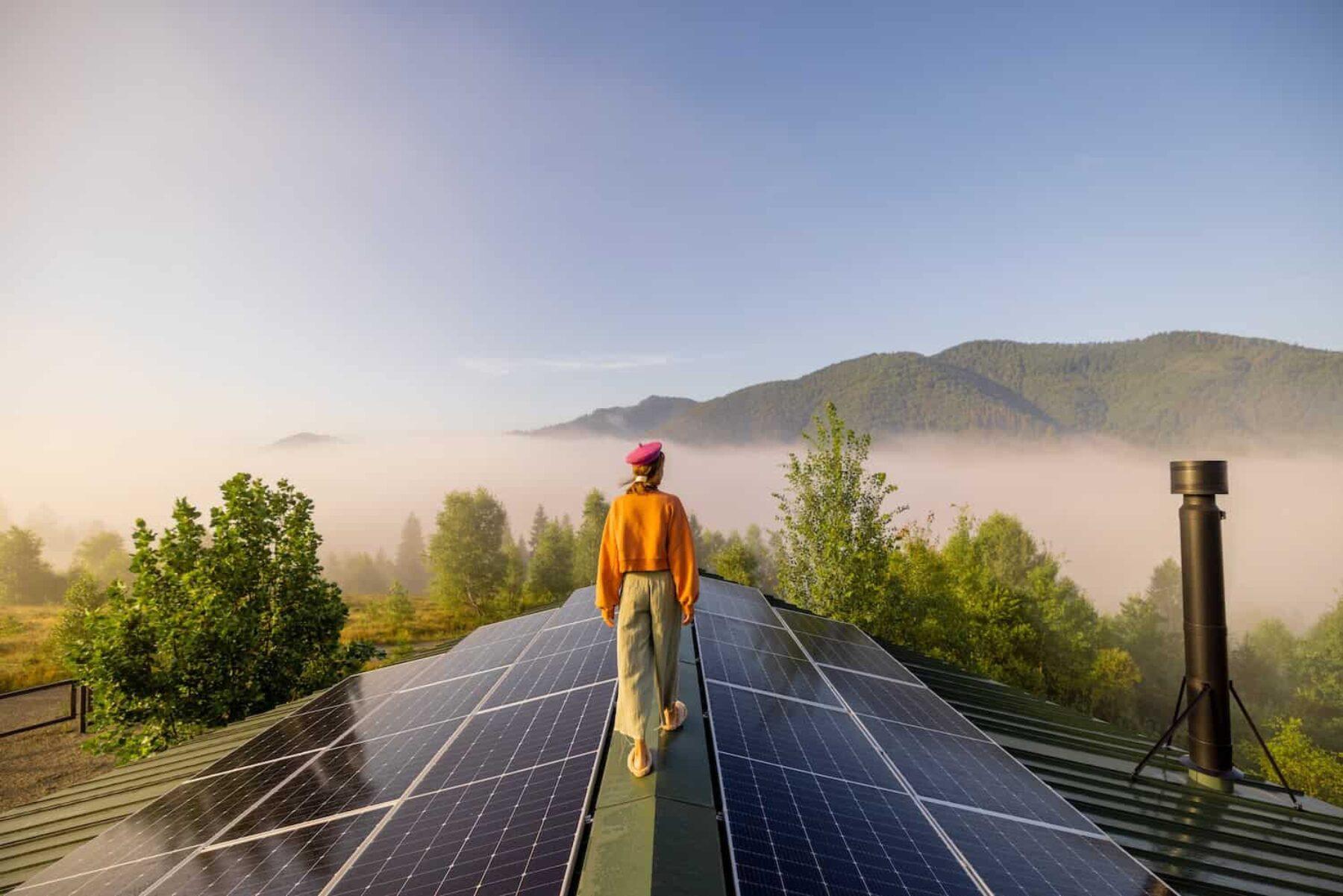

The continuing collapse in the cost of renewables offers a stark contrast to skyrocketing fossil fuel prices – and a cause for optimism
As emissions continue to rise and governments fail to respond with anything like the urgency required, it’s tempting to conclude that the prospects for a liveable planet are growing dim.
But as spring arrives, there is one striking spark of light. Sunlight, to be precise – captured on solar panels and pumping out electrons down the wires, on a scale unimaginable even a decade ago.
The amount of solar installed worldwide doubled between 2022 and 2024 alone. In the first three quarters of 2025, it accounted for 83% of all new electricity-generating capacity. Key to this is the continuing collapse in costs, which have fallen by close to 90% per kWh in just the last decade. Crucially, the cost of batteries – essential for storing the power generated – has plunged by a similar amount in that time.
Over a longer period, the vertiginous fall in solar’s costs is unprecedented for any energy technology: in 1975, it was $100 (£75) per watt. Today it’s just $0.20 (£0.15) – a fall of 99.8%. It used to be just about the most expensive way imaginable of generating power. Now, for much of the world, it is the cheapest.
It’s not just affordability that’s boosting solar, but alacrity, too. In 2004, it typically took a year to install a gigawatt (GW) of solar power (an amount roughly equivalent to the capacity of a nuclear reactor or one of the larger gas-fired power plants). In 2016, that had come down to a week. By 2023, it took just 24 hours. And it’s still falling.
In his new book, Here Comes the Sun, veteran environmentalist Bill McKibben highlights some of the consequences of this double whammy in price and pace. In Pakistan alone, to give one example, enough solar has been installed in the last 18 months to account for one-third of the country’s current grid capacity.

China added nearly 400GW of solar and wind capacity in 2025 – as much as the rest of the world combined. Illustration by Ryan Chapman
Combined with similar, if less dramatic, falls in the cost of wind power (down 80% in a decade), these trends explain why, as of this year, renewables are now growing fast enough to exceed all new global electricity demand, and are already producing more energy than coal.
In the UK, renewables now meet 37% of our needs, compared to 35% from fossil fuels. Sure, the latter still delivers over half the world’s electricity, but their share is starting to shrink. Donald Trump may continue to “dig coal” and rail against the “stupidity” of wind and solar, but when it comes to new power sources, the energy markets are trumping Trump, all while his war in Iran adds fresh urgency to the renewable energy transition.
This has a direct knock-on effect on the prospect for curbing carbon emissions. Globally, these are still on the rise – albeit fractionally. But a shift is under way, and no more strikingly so than the world’s biggest emitter – China. It may be notorious for its large number of coal plants, but it’s also a world leader in renewables. It added nearly 400GW of solar and wind capacity in 2025 – as much as the rest of the world combined.
In 2004, it took a year to install a gigawatt of solar power. By 2023 it took just 24 hours, and it’s still falling
Along with industrial efficiency improvements, this explains why analysts now believe the country’s carbon emissions are flatlining or even starting to decline – despite growing electricity demand. And if China, the world’s factory, can achieve that particular elusive feat of ‘decoupling’, then anyone can.
It’s no coincidence that it’s also leading the way on the electrification of its massive transport feet. One in two vehicles now sold in China is electric. And EVs’ growing market share is now being mirrored elsewhere, including in the UK, where the figure is one in four – and rising. By comparison, petrol car registrations are down by a quarter year on year.
Since power and transport combined account for a hefty share of global carbon emissions, the trends under way here offer an unmistakable ray of hope amid increasingly serious climate warnings. There’s a mountain still to climb, but at least there’s a path to the summit.
Martin Wright is a director of Positive News
Main image: Shutterstock
Be part of the solution
At Positive News, we’re not chasing clicks or profits for media moguls – we’re here to serve you and have a positive social impact. We can’t do this unless enough people like you choose to support our journalism.
Give once from just £1, or join 1,800+ others who contribute an average of £3 or more per month. Together, we can build a healthier form of media – one that focuses on solutions, progress and possibilities, and empowers people to create positive change.