
We shine a light on two individuals pushing boundaries in solar, from sunflower-inspired engineering to transformative perovskite science

From biscuit-tin hack to a solar gamechanger
Jo Fleming, Corrie Energy
Solar photovoltaic energy is a very sophisticated technology, right? So optimising its potential must involve some pretty sophisticated techniques – right? Not like, say, balancing something made out of biscuit tins and cornflakes packets on a picnic table in the back garden.
But that (of course) was exactly what one of the early prototypes of Corrie Energy’s Latitude40 solar tracker consisted of, explains managing director Jo Fleming. It was the start of a path to a technological breakthrough that could produce a striking 30% increase in output of solar installations across swathes of the global north. And in crowded countries like the UK, getting more power out of less area is the holy grail of solar’s potential.
The secret, says Fleming, is the sunflower. A friendly and unassuming bloke whose obvious enthusiasm for his work is conveyed in a soft Scottish burr, he explains how, just as the flower maximises its exposure to the sun by turning to face it as it arcs across the sky, so solar PV should ideally do the same. That way, it gets to generate power right through the day.
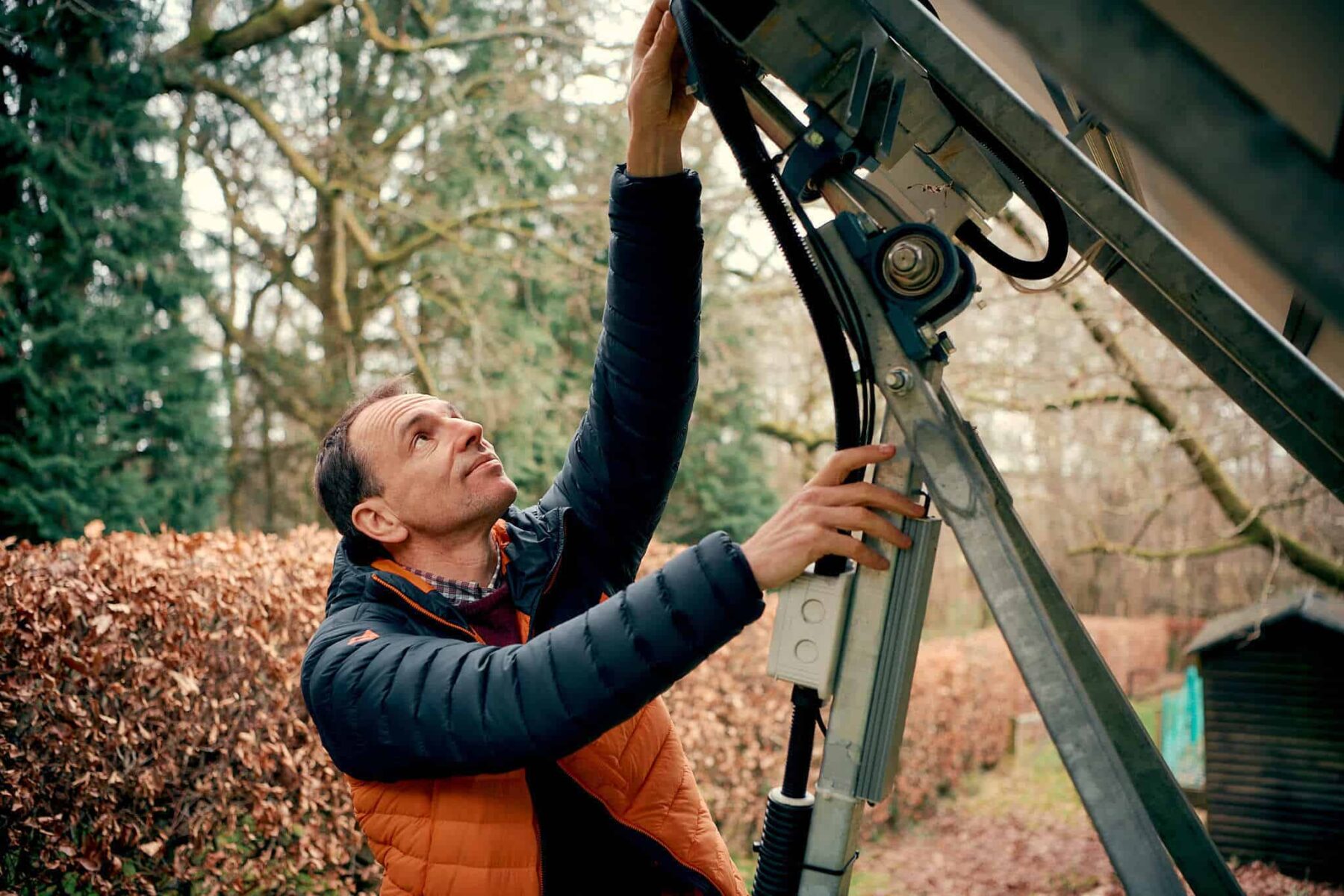
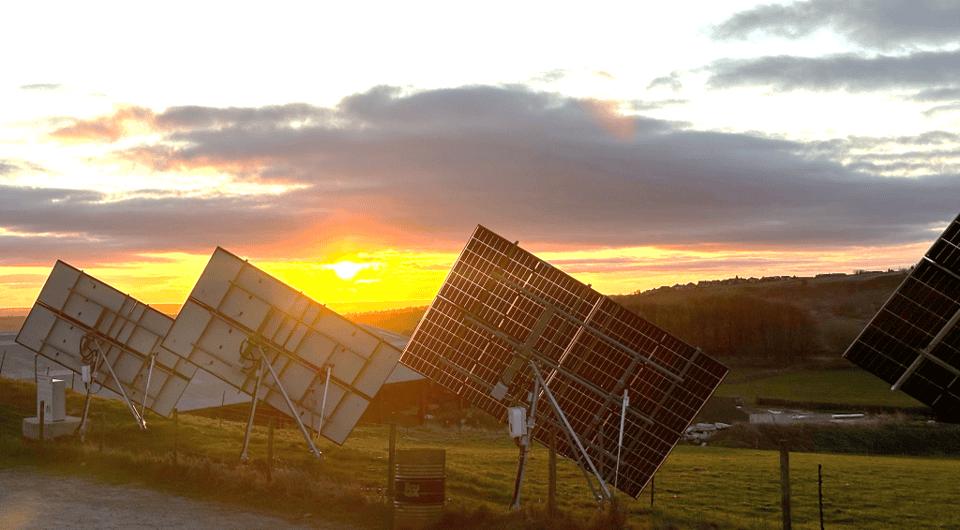
Easier said than done, when solar panels have to be securely anchored on the ground or a roof. But not impossible. Fleming and his colleagues Alan Mathewson and Tony Duffin have been beavering away on renewable energy innovations for 30 years, and were determined to crack this one. Fleming is quick to clarify that it’s not a wholly new idea: in latitudes nearer the equator, “they were taking single solar panels and just rotating them on really long poles from facing east in the morning, to flat upright at noon, and then west in the afternoon”.
These ‘single axis’ arrangements don’t work north of the so-called ‘sunbelt’ (up to 40 degrees latitude), since the sun doesn’t get anywhere near overhead at noon. So a more sophisticated solution is needed: one that can track the sun as it passes through its various angles during the day. Fleming freely admits they weren’t the first people to wrestle with it. “We found lots of patents out there, going back decades, and [many of them] were trying to be like a radar dish, pointing everywhere in the sky. But you don’t need to do that in Britain and other northern latitudes. The sun is only in one hemisphere, and within that hemisphere, it’s only ever rising to 60 degrees, even at the height of summer.”
So much for the technical task: then there’s the challenge not just to make it work, but to do so in as cost-effective a way as possible. “By definition, you generate least at dawn or dusk”, says Fleming, so cutting out the angles needed to meet the rays at those times loses only a fraction of generation capacity, but helps keep the resulting tripod design as simple as possible.
You need designs to be cheap, easily available, easy to replace: screw them in, screw them out
“Simplicity is key”, he says. That’s how to balance effectiveness with affordability. “You don’t want it to be over-engineered, you don’t want to have to wait weeks for expensive replacement components to be shipped in from Germany or wherever. You need designs to be cheap, easily available, easy to replace: screw them in, screw them out.”
Hence all those years of experimentation, starting off in the back garden and moving through ever more sophisticated versions to today, with fully-working prototypes having undergone robust testing in the field. It hasn’t come cheap – “We’ve invested about £1 million over seven years” – but Corrie’s ability to prove the design worked helped secure substantial funding from Innovate UK and others, and with field testing complete, they’re on the cusp of full commercial rollout.
The Latitude40 is now poised to help Britain and other northern countries make a step-change in harvesting their full solar potential. Not bad for something inspired by a sunflower, and starting with a biscuit tin.
The physicist whose breakthrough could outshine silicon
Henry Snaith
When physics student Henry Snaith was graduating, back at the turn of the century, solar power was one of the most expensive ways of generating electricity. “It was about 20 times the cost of nuclear,” he recalls. “Not remotely realistic for powering the world.”
But that fact sparked his curiosity. He was concerned about climate change and felt that as a physicist, he could do something about it. The most obvious area to get involved in was energy, specifically “wind, solar or nuclear fusion”. He decided against wind (“which is more engineering than physics”) and fusion (“too far off in the future”). Which left solar. Its relative expense was part of its appeal: “I liked it because it actually works, but there’s lots of opportunity to make it better.”
Over the next two decades, of course, solar costs have tumbled. “No one thought it would get as cheap as it has. It’s an incredible story of scaling and automation.” But that was still to come, when the new graduate was writing to companies like the now-defunct BP Solar, looking for a research job. “They got back to me and said: ‘If you want to do industrial research, you need a PhD’. So I thought: ‘Oh well, I’d better do one then!’”
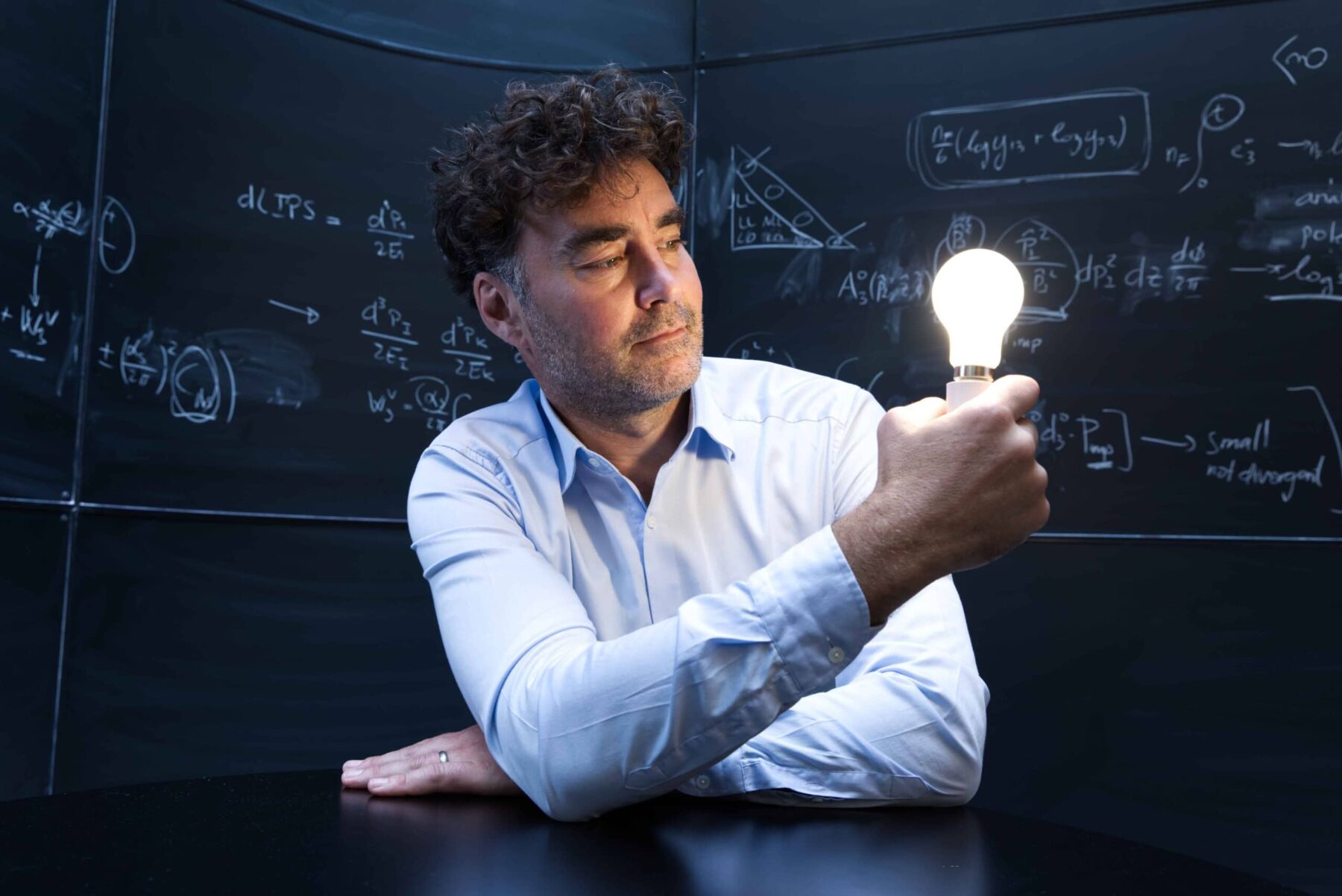
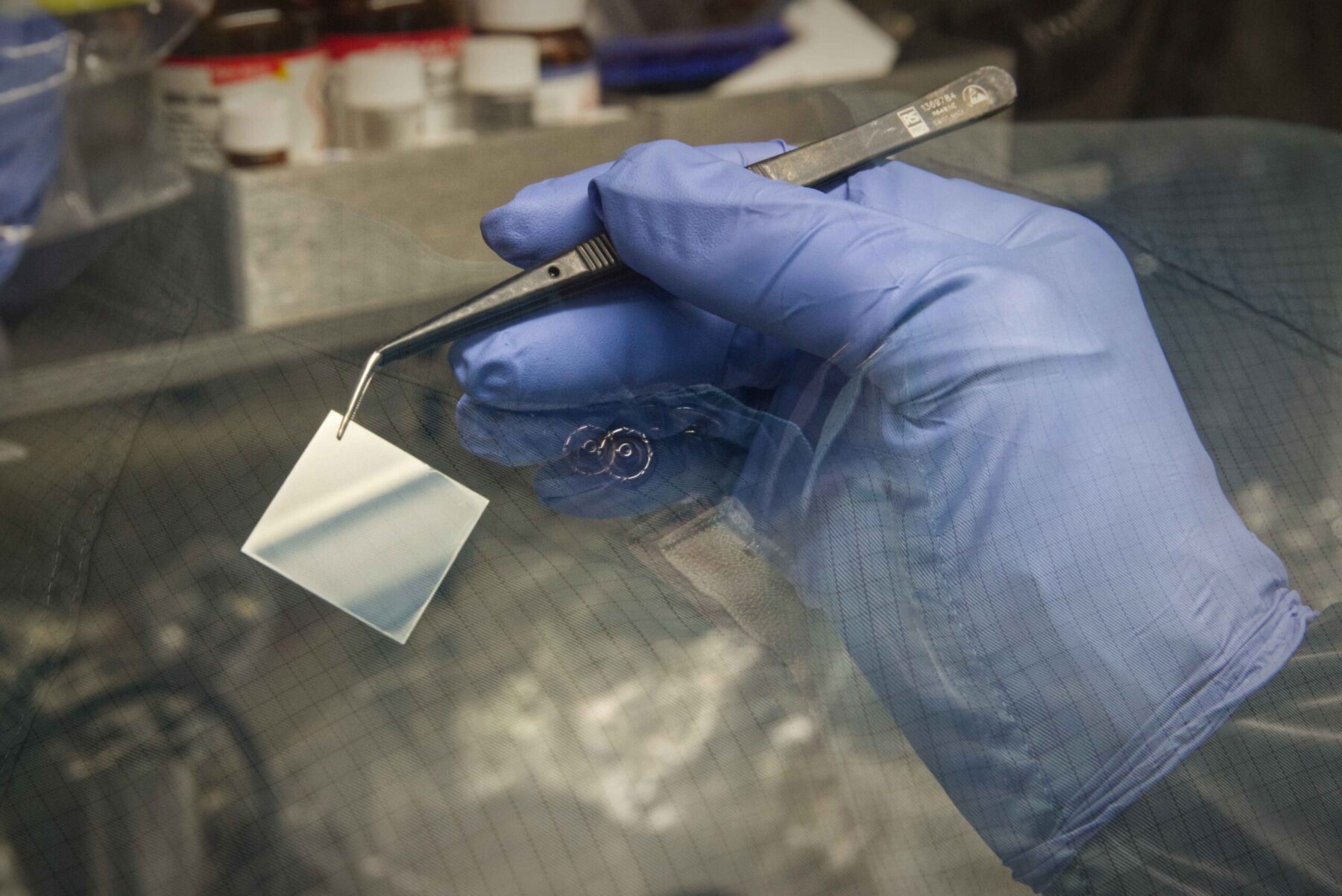
So what to focus on? Silicon photovoltaics – the sort you see on standard solar panels – was well established, and Snaith, with a fascination for frontier research and an eye on future career prospects, was looking for something “beyond what industry was already doing”.
Initially his research focused on polymer solar cells, but as it developed, it shifted to the potential of novel thin-film versions, using a mineral called perovskite. Their great advantage is that they are thin and flexible enough to apply as a coating to almost any surface, including buildings, but also a host of other uses, from rucksacks to cars and even phones. Suddenly, solar doesn’t have to be confined to clunky solar panels, at a stroke massively increasing the places in which it can generate power.
While exciting in itself, the real prize was discovering how, as Snaith explains, “by stacking layers [of perovskite-based PV] together, each of them absorbing a slightly different section of the solar spectrum”, they could bring its efficiency close to, and even beyond, the best achieved to date by ‘traditional’ silicon.
We were walking around conferences watching everyone presenting their stuff, knowing that a bombshell was about to hit. It was very surreal
“The first time we put them in a solar cell, we got 6% efficiency. Within a few months, we got to 10%, which was our all-time end goal.” By which point, Snaith and his team felt, it could potentially become viable as an alternative to silicon. He was discovering that “nothing generates charge and voltage when you shine sunlight on it like a perovskite.”
With his genial, laid-back manner and a thick tangle of curly dark hair, Snaith could pass for the Brian May of solar power. But his relaxed style belies the extent of the revolution he and his Oxford-based team were quietly fomenting. At that time, he recalls, his research group numbered around a dozen people: “small enough that information didn’t leak out”, before they were ready to go public. “We were walking around conferences watching everyone presenting their stuff, [secretly] knowing that a bombshell was about to hit them. It was a very surreal time.”
By 2024, they were achieving efficiency rates for the perovskite cells of 27% – equal to the best recorded by silicon – and seemed set to go higher still. A commercial company, Oxford PV, with Snaith as its chief scientific officer, has now been spun off to exploit the market opportunities. It’s still early days, but already it’s holding out the possibility of massively increasing the amount of solar power that can be generated in the UK and elsewhere, since it doesn’t just have to be confined to massed arrays on solar farms, or panels on rooftops.
So how does Snaith feel to be at the heart of the revolution? He smiles. “Well, when we get to the point that we have multiple gigawatts of perovskite PV being produced, and it’s transitioning to become the dominant technology, because it’s better and produces more power per square metre, I’ll probably look back and think: ‘Wow, I was lucky to be on this journey.’ But right now, I’m still in the middle of it and there’s still lots to do.”
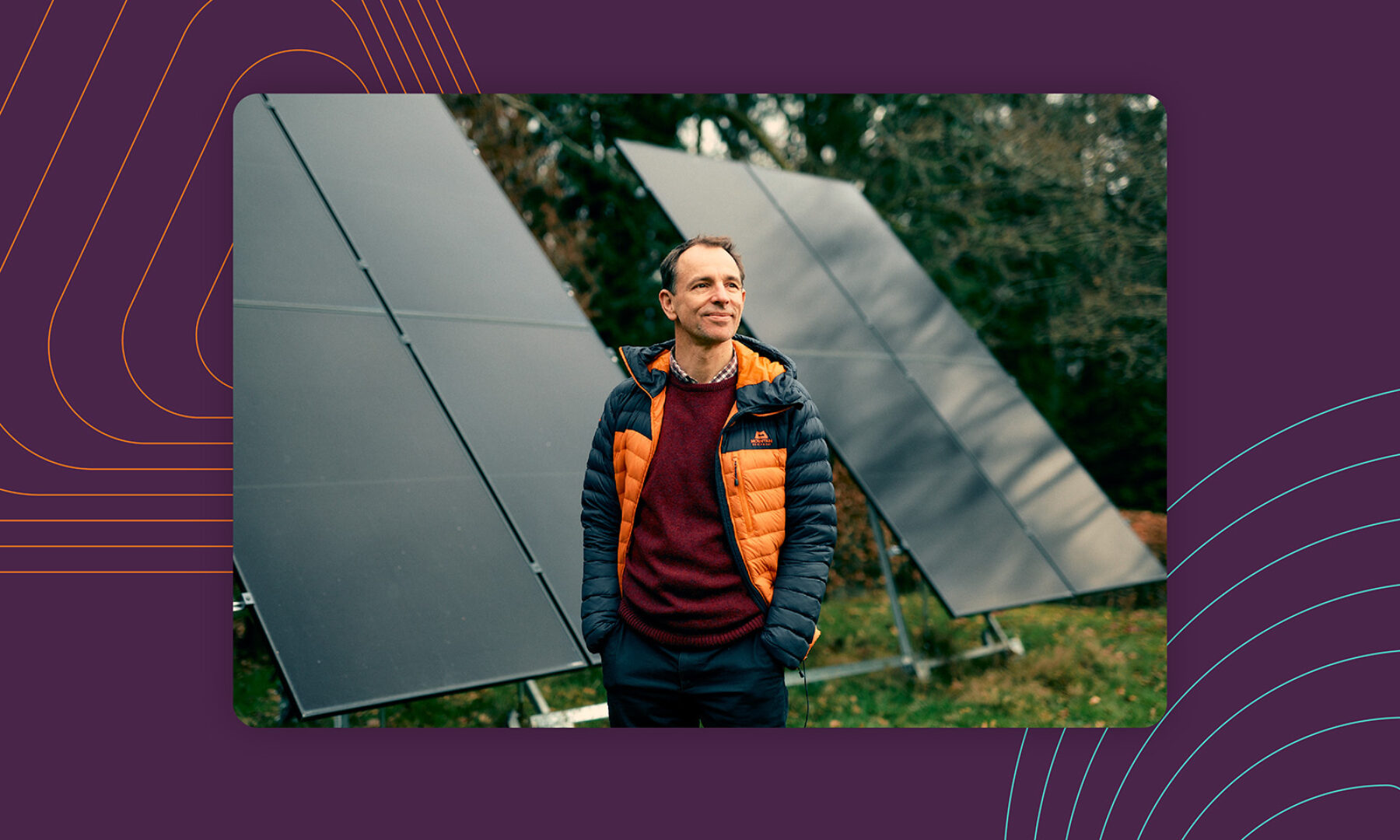
Main image: Jo Fleming, photographed by Harry Lawlor